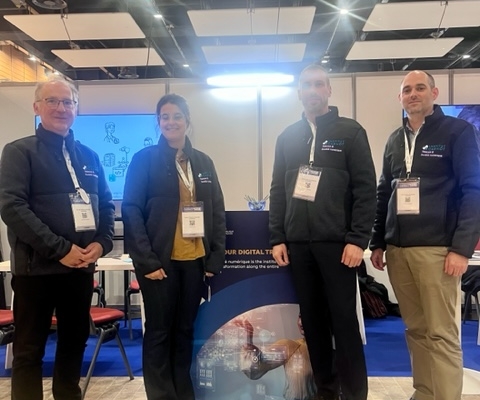
In March 2023, at the Mobile World Congress 2023, the O-RAN ALLIANCE and the OpenAirInterface Software Alliance (OSA) announced the signing of a memorandum of understanding. The aim of this agreement is to strengthen collaboration between the two organisations, with a view to making the Radio Access Networks (RAN) industry more open. This is a clear rapprochement between two partners driven by similar philosophies.
OpenAirInterface : a complete 4G/5G experimentation platform
The OpenAirInterface (OAI) platform, which has Carnot TSN accreditation, provides an open source software suite for reproducing a complete 4G or 5G mobile network environment. Open to all, it can be used by any user wishing to test a service, by combining it with hardware equipment to recreate real networks on a reduced scale. « All the components of a telecoms network, from one end of the chain to the other, are taken into account by OAI: from the core network to the terminals, via the base stations », explains Navid Nikaein, researcher at EURECOM and member of the OAI executive committee. « And what is particularly interesting for researchers is that they can combine open-source software bricks with proprietary systems to create an environment that perfectly matches their needs.
This is the population for which the platform is primarily intended. « OAI was designed to meet the needs of researchers wishing to carry out real-time experiments and proofs of concept for systems based on mobile networks, » explains Raymond Knopp, researcher at EURECOM and Chairman of the OpenAirInterface Software Alliance. « Since then, many manufacturers have been using the software suite for tests, including Orange and Airbus.
The French operator has used the platform to test services on its future 5G networks at several sites in France and Europe. It has also used it to carry out experiments in the town centre of the Romanian municipality of Alba Iulia. Navid Nikaein worked on this project: « In particular, the company wanted to study the behaviour of a network combining open source software with commercial solutions, in this case from the French company AW2S ».
As for the aircraft manufacturer, it worked with the OAI teams as part of the European « 5G!Drones » project. The aim is to produce a proof of concept for a civil security application, using drones equipped with 5G sensors, capable of recording videos in real time and collecting various measurements in the field.
A platform promoted by the OpenAirInterface Software Alliance
These examples illustrate the potential applications of OAI. To encourage its development, promote its use and ensure its integrity, EURECOM created an endowment fund associated with the platform in 2014. Called the OpenAirInterface Software Alliance, its primary aim is to collect donations from players in the telecoms industry, with a view to keeping the OAI ecosystem alive.
But that’s not its only purpose. « The platform is also open to contributions from its community, » adds Raymond Knopp. « Companies from all over the world are involved in enhancing the software suite and improving its reliability. The OSA then steps in to coordinate the various contributors and help smaller players in particular to make their contribution.
As a result, OpenAirInterface is constantly being enriched, thanks to the activity of its community and the work of EURECOM researchers. « We recently added O-RAN’s intelligent controller, called RIC, to OAI, » says Navid Nikaein. « So we were already interested in this architecture before we signed the agreement. »
Open RAN: for interoperable, intelligent radio access networks
But what is it all about? Open RAN (Open Radio Access Network) is an initiative aimed at establishing standards for radio access networks, to make them more open, interoperable and intelligent. Today, RAN hardware and software components are produced by a small number of equipment manufacturers, each with its own proprietary system. Open RAN aims to break free from these constraints and give operators the freedom to combine components sold by different manufacturers.
This initiative would also make networks more adaptable, thanks to the RIC (RAN Intelligent Controller). This software component, based on artificial intelligence, is capable of automatically adjusting the network according to its state, the needs of users and their location. This is a way of optimising energy consumption and costs, by modulating the power emitted according to the situation.
O-RAN ALLIANCE: the major telecoms operators’ quest for openness
The O-RAN ALLIANCE was created in 2018 to promote this open architecture. The project is spearheaded by five of the world’s major telecoms players: AT&T, China Mobile, Deutsche Telekom, NTT DOCOMO and Orange. « It’s a kind of arm wrestle between the biggest international operators and the equipment manufacturers, » sums up Raymond Knopp. « The aim of the O-RAN ALLIANCE was to open up network interfaces, which are not currently standardised by 3GPP. Although the 3rd Generation Partnership Project (3GPP) – which brings together the main telecoms standards bodies – sets standards for mobile networks, it does not currently cover all the components of a network. O-RAN is therefore seeking to extend this standardisation work.
« Today, a player like Orange relies mainly on components supplied by Nokia and Ericsson, » says Raymond Knopp. « Operators would therefore like to open up the industry to new equipment manufacturers, in order to have a wider choice for all network interfaces. The O-RAN ALLIANCE has also developed a range of open source software, in collaboration with the Linux Foundation, to encourage the use of its specifications. This open source approach has led to closer links with OAI: « We have been able to build solutions combining elements of O-RAN and OpenAirInterface, » says the OSA chairman. This was demonstrated at Mobile World Congress 2023, just before the announcement of the agreement between the two entities.
OSA-O-RAN ALLIANCE agreement: 6G in focus?
The O-RAN ALLIANCE and the OSA have therefore signed this memorandum of understanding. What form will the collaboration take? « Discussions are still under way to define the precise contours of this agreement, » says Raymond Knopp. « For our part, we are going to integrate the O-RAN specifications more fully and encourage our partners to use them. As for the operators, they see a real advantage in using a totally open solution like ours, rather than proprietary systems ». The O-RAN ALLIANCE will promote the use of OAI within its community and beyond, notably through deployment specifications based on the platform. It also sees OAI as a means of testing future generations of mobile networks.
Because, at the moment, his ideas are not unanimously supported. « The major equipment manufacturers are very wary of O-RAN, » says Navid Nikaein. « In their view, having to interconnect with the systems of other suppliers is likely to affect the quality and reliability of their services. The consortium of operators still has some way to go before its specifications become genuine standards, adopted and validated by 3GPP. « While the O-RAN ALLIANCE has recently made significant progress, everything remains to be proven, » concludes Raymond Knopp. « And its work may not lead to results for 5G, but possibly more for 6G. A goal that the O-RAN ALLIANCE would like to get closer to, thanks in part to its collaboration with the OSA.





 https://www.carnot-tsn.fr/wp-content/uploads/2023/11/IMG_5523.jpg
480
640
India Senouci
https://www.carnot-tsn.fr/wp-content/uploads/2021/09/logo-carnot-tsn.png
India Senouci2023-11-20 17:34:312024-02-05 17:43:32[Vidéo] IMT SDR-Lab : Réseau et sécurité radio des systèmes cellulaires
https://www.carnot-tsn.fr/wp-content/uploads/2023/11/IMG_5523.jpg
480
640
India Senouci
https://www.carnot-tsn.fr/wp-content/uploads/2021/09/logo-carnot-tsn.png
India Senouci2023-11-20 17:34:312024-02-05 17:43:32[Vidéo] IMT SDR-Lab : Réseau et sécurité radio des systèmes cellulaires